From Member Value to Collective Value
Why engaged members are becoming an EU association's strongest asset
Members are asking harder questions about the fee they pay and the time they give, policymakers want evidence from the ground, and more of each EU file is now decided in national capitals. An EU association has something no one else can offer: its members, with their evidence, their expertise and their readiness to stand behind a joint position. The associations putting that collective to work are making four shifts: from audience to contributors, from informing members to working with them, from meeting often to learning from each other, and from platform first to strategy first.

Mathijs Vleeming
26 Oct 2026
8 min read
A working group spends six months on a joint position paper. The secretariat circulates three drafts, and each time a handful of members send comments, often the same handful as last time. The paper is adopted, launched at a Brussels event and posted on the website. Back home, few members take it to their national ministry, their national association or their own customers. The members who shaped it use it. Most of the others, whose support the paper claims, move on to the next file.
The appetite to do more is there. In MCI's Association Engagement Index, 31% of members said they were highly interested in contributing more actively to their association. Only 22% felt encouraged to, and just 15% found it extremely easy (MCI, 2024; AMI, 2026).
In From Position to Purpose, we set out four pivots for EU associations: from monitoring to foresight, representing to facilitating, position to service, and staffing to capability (Lipps, 2026). Each of them depends on members who take part. This article looks at the members' side of that answer.
The membership deal EU associations were built on
For decades the deal was simple. Members paid a fee, and the secretariat followed EU policy, kept members informed, organised the congress and spoke for the sector. The secretariat produced the value, and members received it. The deal assumed that information about Brussels was scarce, and that the secretariat's access was the product.
Three forces are now changing that deal.
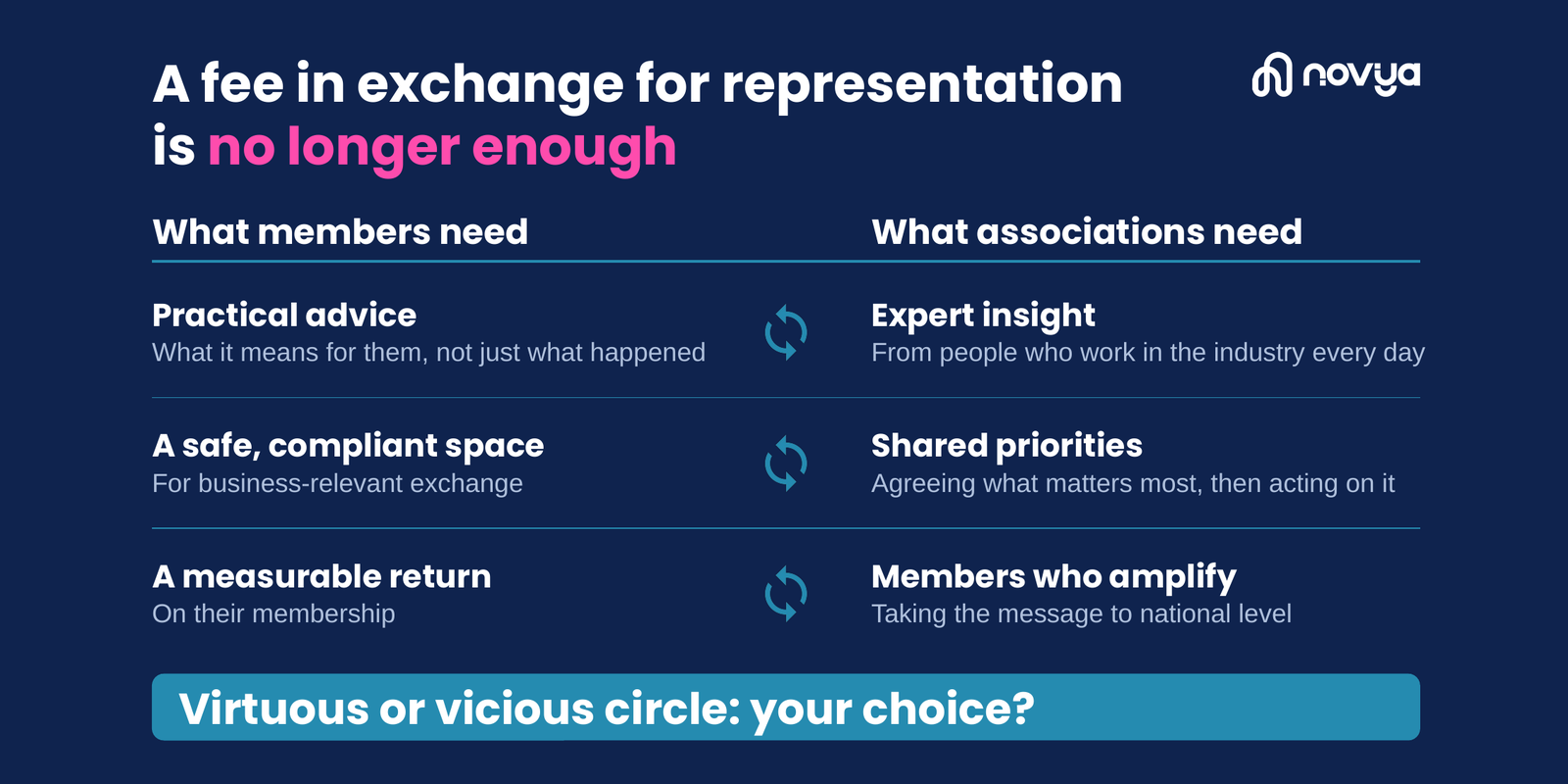
1. Members want a measurable return on their fee and their time.
The question at renewal now covers two investments: the fee, and the hours members' experts spend in working groups, task forces and drafting rounds. Whoever represents the member has to justify both to their own management. With AI tools, any member can summarise a Commission proposal in seconds, so the fee has to buy more than the news.
A fee in exchange for representation no longer does the job on its own. Participation shows at renewal: in a 2025 report by the community-platform provider Forj, 87% of frequent participants said they would definitely renew, against 74% of the rest (Forj, 2025).
2. Policymakers want evidence from the ground.
The Commission has been explicit about this. In 2025, every member of the College held Implementation Dialogues to hear where EU rules create friction, uncertainty or unnecessary costs: 51 dialogues with 1,049 stakeholders from all 27 member states (European Commission, 2025). What counts in those rooms is what only members hold.
Collective data. BusinessEurope's Omnibook sets out almost 140 simplification proposals across ten policy areas, and grounds its case in member surveys that rank regulatory burden as the first challenge to investment in the EU (BusinessEurope, 2026). A single company's figures are easy to set aside. A whole sector's are much harder to ignore.
Case stories. As From Position to Purpose showed, a sector can win the wording of a file and still lose the public narrative (Lipps, 2026). Narratives are built from real cases: the plant, the SME, the product line a rule will change. Only members can supply them.
The right people in the room. When around 70 industry leaders presented the Antwerp Declaration in February 2024, with Commission President Ursula von der Leyen and Belgian Prime Minister Alexander De Croo present, the initiative was led by an association, the European Chemical Industry Council (Cefic, 2024; Euronews, 2024). Chief executives who want to speak for themselves still need someone to convene them, prepare them and connect their message to the sector's.
Gathering any of this is engagement work. It depends on members who answer when the secretariat asks, and who trust the association with their numbers and their stories.
3. More of each file is decided in national capitals.
Brussels proposes, and national leaders increasingly steer. In November 2024, EU leaders used the Budapest Declaration to call for a "simplification revolution" and asked the Commission to propose cutting reporting requirements by at least 25% in the first half of 2025 (European Council, 2024). The first omnibus simplification package followed in February 2025 (Mayer Brown, 2025). In 2025, eleven member states asked the Commission to delay and soften the Deforestation Regulation, and by November the Council had backed a second one-year postponement (Business & Human Rights Resource Centre, 2025). Once a rule is adopted, national authorities decide how it is applied.
An association working from Brussels alone hears about these shifts late. Its members and national member associations are already in the capitals, and can take its message to the people deciding the file.
Four shifts that bring members into the work
The shifts below build on what most associations already run: working groups, consultations, the congress. They change who contributes, and how easily.
1. From audience to contributors.
Most members start by consuming. They read the briefing, join the webinar, open the newsletter. That is a perfectly good place to start, and many will stay there. Our task is to make the next step easy for those who are ready to take it.
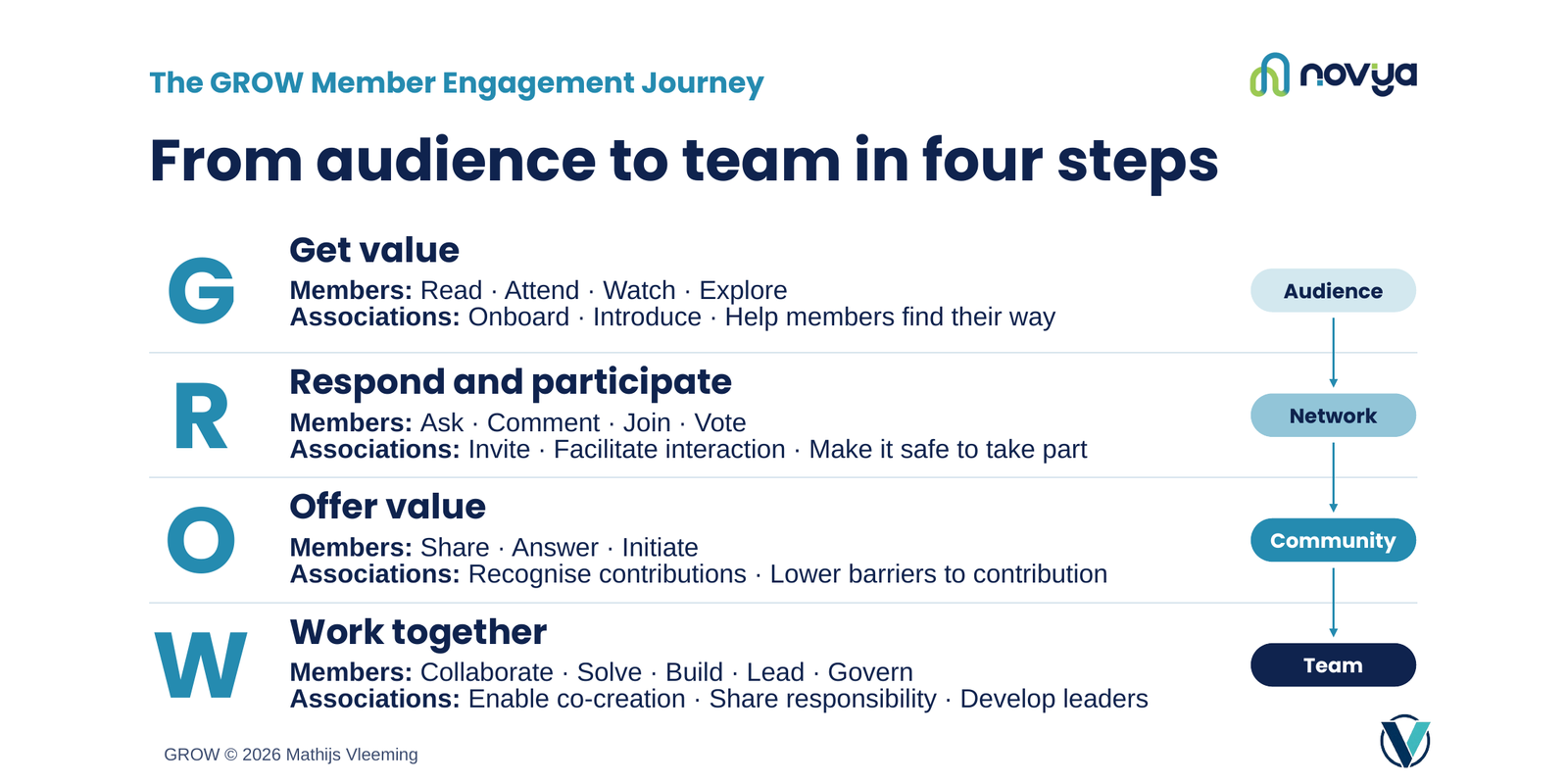
The GROW journey maps four steps, each with a job for the association: Get value, Respond and participate, Offer value and Work together. On a policy file, a member might move from reading a briefing, to answering a member consultation, to submitting evidence, to agreeing a joint position and presenting it to their own national ministry. In professional development, the same member might move from reading a guide, to asking a question in a webinar, to sharing a practical case, to developing a guide or standard with peers.
The MCI figures point to where the effort pays: small, specific invitations. Ask a member to answer one question, share one case or check one figure. A seat on a committee asks for a standing commitment, whereas testing a draft paragraph takes twenty minutes.
2. From informing members to working with them.
Start from the challenges members share right now, rather than from the association's own calendar. The most productive ground is often pre-competitive: how to apply a new reporting obligation, how a standard will be tested, how to close a skills gap, how a national authority is reading an EU rule.
Etienne and Beverly Wenger-Trayner call the structure for this a community of practice: people who share a domain, interact regularly and build a shared repertoire of cases, tools and methods (Wenger-Trayner and Wenger-Trayner, 2015). A practice group of compliance or technical managers gives members a reason to engage between plenaries. Where members compete, it runs under the competition-law protocol the association already applies to its meetings. It also gives the secretariat a direct line to the problems members are dealing with now.
The same logic applies to positions. Members who helped shape a position have a stake in defending it, including in their own national capital.
3. From meeting often to learning from each other.
Most EU associations meet constantly, in working groups, committees, task forces and the board. The real question is what kind of exchange those meetings create. Reporting tends to fill the agenda: the secretariat updates, members listen, the minutes go out. What members often value most is what they learn from each other, such as how a peer solved the problem they face now. Swap some of the updates for real cases and people have a different reason to turn up.
Between meetings, digital channels keep the exchange going. For multinational member organisations they are also an equaliser: members in different countries, languages and time zones can contribute without the cost and time of travelling to the next meeting, wherever it is held. Having a platform is the easy part, and many associations already have one. Like the AGM or the congress, it works when someone is responsible for it: planning the rhythm, inviting members in, connecting the right people and following up. Evofenedex, the Dutch association for companies in trade and logistics, runs more than 15 active member communities with dedicated community managers, and more than 65 community events a year (Evofenedex, n.d.).
"With more than 15 active communities, each supported by a dedicated community manager, we stay continuously connected to our members. This allows us to understand what matters to them and what challenges they face. Within our communities, members gain knowledge, expand their professional networks, and connect with peers who share similar challenges and ambitions. Through more than 65 community events each year, our community managers bring people together, stimulate knowledge exchange, and strengthen professional practice."
— Sandra Gelderland, Manager, Communities & Member Relations, evofenedex
4. From platform first to strategy first.
This is what we see most often. When engagement stalls, the instinct is to buy a tool, launch it at the congress and hope members follow. Months later, most of the activity comes from the secretariat.
At Novya, we start somewhere else. We sit down with the secretariat and the members who will lead, and ask what the association wants to achieve. Which members do we want to involve, and around which shared challenge? What should they be able to do together that they cannot do today, and what would show it is working? Who will lead, and what rhythm will keep it going? Then we design around the answers together: the journey, the roles, the rituals and the measures. Only then do we look at tools, starting with the ones the association already has.
Vastgoed Nederland, which represents real estate agents in the Netherlands, shows why the order matters. Its members post around 75 questions and 490 answers a month on the association's member platform, and 90% of members registered within five months, according to a case study by its platform provider (Yunits, n.d.). Other associations run similar software with far less activity. The difference was a strong shared identity among members, and an association that answered what they asked with relevant services.
The associations members will stand behind
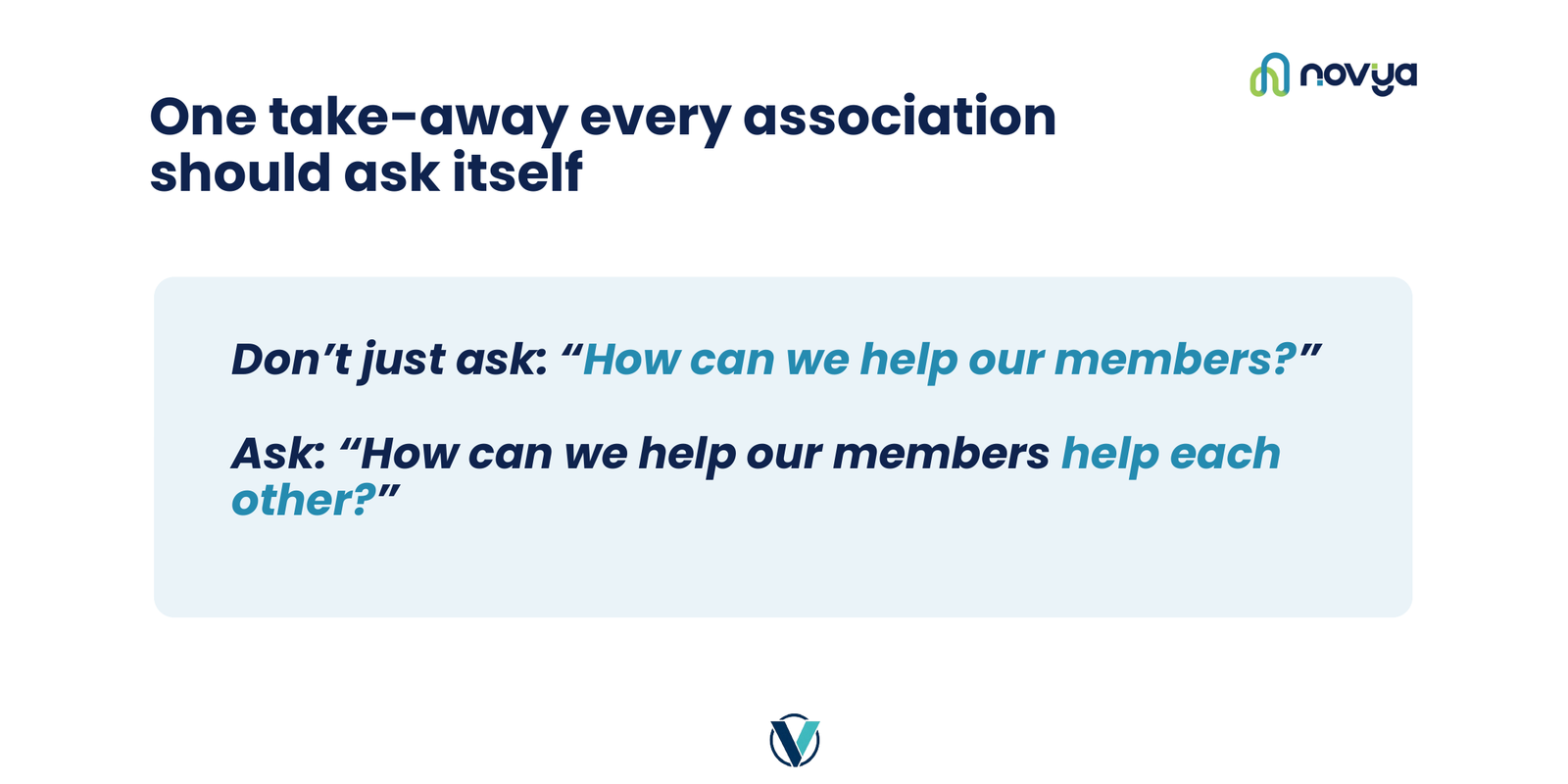
Associations were founded on the idea that members achieve more together than alone. In Brussels, that has often meant members handing their voice to the association, which then speaks for the sector. The next step is working together: on the evidence, on implementation and on making the case at national level. Done well, it gives the member representatives who already invest their time a real return on it, instead of one more task.
Anyone can monitor Brussels, and many chief executives can ask their team to arrange a meeting with a Commissioner. Only an association can bring the evidence, the knowledge from the ground, the collective foresight and the commitment of a whole sector or profession. It can do that when its members understand and value their role as active contributors. The associations that invest in turning their audience into contributors will take stronger evidence to the institutions, be heard in national capitals as well as in Brussels, and give members a clear answer about added value at renewal.
Associations create value. Engaged members multiply it.
Watch Mathijs Vleeming and Benita Lipps discuss From Member Value to Collective Value in the Novya Association Brief.
About the author
Mathijs Vleeming is a Novya Expert in Association Engagement and Community Strategy. He spent 20 years at ICCA, including as Director of Marketing, and has since worked as a community strategy consultant for organisations in the Netherlands and across Europe. He developed the Association Engagement Method and serves on the board of the Community Consultants Collective.
References
AMI (2026). Association engagement has stalled. Are meetings the key to changing it? https://www.amimagazine.global/Membership/Engagement/Association-engagement-has-stalled-Are-meetings-the-key-to-changing-it-
Business & Human Rights Resource Centre (2025). EU Council's position supports second one-year postponement of the Deforestation Regulation. https://www.business-humanrights.org/en/latest-news/eu-councils-position-supports-second-one-year-postponement-of-the-deforestation-regulation/
BusinessEurope (2026). BusinessEurope launches its Omnibook of proposals for reducing regulatory burden for companies in Europe. https://www.businesseurope.eu/publications/businesseurope-launches-its-omnibook-of-proposals-for-reducing-regulatory-burden-for-companies-in-europe/
Cefic (2024). Antwerp Declaration for a European Industrial Deal, February 2024. https://cefic.org/news/antwerp-declaration-for-a-european-industrial-deal/
Euronews (2024). Industry chiefs warn of over-regulation, demand change of tack. https://www.euronews.com/2024/02/20/industry-chiefs-warn-of-over-regulation-demand-change-of-tack
European Commission (2025). Implementation Dialogues: Listening to Deliver. https://commission.europa.eu/law/law-making-process/better-regulation/simplification-implementation-and-enforcement/implementation-dialogues-0/2025-implementation-dialogues_en
European Council (2024). The Budapest Declaration on the New European Competitiveness Deal. https://www.consilium.europa.eu/en/press/press-releases/2024/11/08/the-budapest-declaration/
Evofenedex (n.d.). Statement by Sandra Gelderland, Manager, Communities & Member Relations, quoted with permission. https://www.evofenedex.nl/
Forj (2025). 2025 State of Association Member Experience Report: The Experience Matters. https://www.forj.ai/2025-state-of-association-member-experience
Lipps, B. (2026). From Position to Purpose: Why EU trade associations need to reinvent themselves. Novya. https://www.novya.eu/articles/why-eu-trade-associations-need-to-reinvent-themselves
Mayer Brown (2025). European Commission presents Omnibus Simplification Package. https://www.mayerbrown.com/en/insights/publications/2025/02/european-commission-presents-omnibus-simplification-package-with-amendments-to-csrd-csddd-cbam-and-taxonomy
MCI (2024). Unlock the secrets to enhanced engagement with the 2024 Association Engagement Index. https://wearemci.com/en/thoughts/unlock-the-secrets-to-enhanced-engagement-with-the-2024-association-engagement-index
Wenger-Trayner, E. and Wenger-Trayner, B. (2015). Introduction to communities of practice. https://wenger-trayner.com/introduction-to-communities-of-practice/
Yunits (n.d.). Vastgoed Nederland: samen sterker in de vastgoedmarkt (case study, Dutch). https://www.yunits.com/klantcases/vastgoed-nederland-samen-sterker-in-de-vastgoedmarkt/