From Position to Purpose

Why EU trade associations need to reinvent themselves

Across Brussels, EU trade associations are being reshaped by four forces: complex policy dossiers, CEO-led representation, NGO-driven narratives and multi-level geopolitics. The associations that will matter in the next decade are already making four pivots in response: from monitoring to foresight, from representing to facilitating, from position to service, and from staffing to capability.

Image Description
Benita Lipps
  • 02 May 2026
  • 7 min read 

Image Description
In March 2026, five chief executives took a Brussels stage together. Nicolas Hieronimus of L’Oréal, Gilles Andrier of Givaudan, Dimitri de Vreeze of dsm-firmenich, Erik Fyrwald of IFF and Vincent Warnery of Beiersdorf — competitors on the shelf, peers in policy — addressed the European Union directly through the Value of Beauty Alliance, the CEO network they had founded together in January 2024 (CosmeticsDesign Europe, 2025). Their industry’s traditional trade association sat in the room. A year before, several of those CEOs would have sent their head of public affairs with a position paper. They were now doing the talking themselves.

This is not a beauty patch — it is a seismic shift in the way companies want their collective interests represented in Brussels.
Image Description

The association model Brussels was built on
EU trade associations were built for a unique policy era — one where a single Directorate-General produced a single directive, where the secretariat was then able to have a friendly chat over coffee or was invited to submit a well-researched position paper, where membership dues funded a permanent staff of technical experts, and where the EU institutions were the only ones that truly mattered. That model was elegant when files moved one at a time, when board membership was for life, when NGOs were peripheral, and when global geopolitics did not force their way into many Council conclusions. None of those conditions still hold.
Image Description

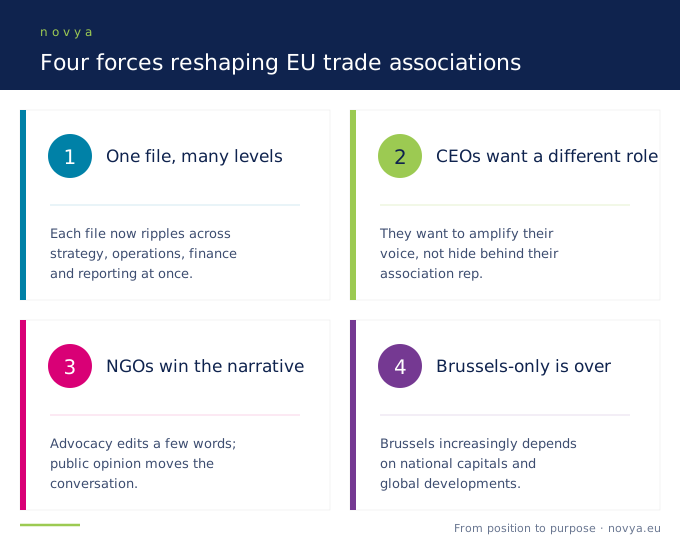
Four forces reshaping EU trade associations

1. Policy now travels in bundles, not single files.
The Commission’s own Competitiveness Compass, presented in January 2025, opened with President von der Leyen’s blunt verdict that “many firms hold back investment in Europe because of unnecessary red tape,” and committed to cutting administrative burdens by 25% across the board and 35% for SMEs (European Commission, 2025). The Omnibus Simplification Package that followed in February 2025 is the diagnosis dressed as legislation: it bundles CSRD, CSDDD, CBAM and the Taxonomy into a single rescue operation, an admission that these files were never going to be defended in isolation (Mayer Brown, 2025).
 
The European Round Table for Industry has documented what this looks like inside a member’s accounts — a 40% year-on-year increase in CSRD-related reporting costs for a large industrial company (ERT, 2025a). BusinessEurope’s Omnibook, published in three tranches across 2025 and January 2026, mapped some 140 regulatory burdens across ten policy areas, treating them as a portfolio (BusinessEurope, 2026). The Draghi report set the underlying number: more than 60% of EU companies see regulation as an obstacle to investment, and 55% of SMEs flag it as their greatest single challenge (Draghi, 2024).
 
For a trade association built around a set of single files, that complexity is unmanageable. Cumulative-impact thinking is now a core competence, not a footnote.
Image Description

2. A new generation of CEOs wants a different role. 
The Value of Beauty Alliance is the most visible example, but it sits inside a broader pattern. The European Round Table for Industry, with around 60 chief executives of multinationals representing more than €2 trillion in combined revenues, elected Mercedes-Benz Group Chair Ola Källenius as its president for 2025 — a visible CEO willing to spend his calendar on European competitiveness (ERT, 2025b). In February 2024, 73 business leaders from seventeen sectors signed the Antwerp Declaration for a European Industrial Deal in a single, CEO-led act (Cefic, 2024). The IFPMA’s Biopharmaceutical CEO Roundtable met directly with Greek Prime Minister Kyriakos Mitsotakis in April 2024, bypassing the secretariat-led format altogether (IFPMA, 2024). 
 
Founders, family-business heirs and the regional CEOs running EMEA and other major markets expect their associations to amplify their voice, not absorb it, while senior Commission officials increasingly prefer to hear directly from CEOs and senior business leaders.
Image Description
3. NGOs are winning the narrative even when industry wins the text. 
 
When it comes to EU alcohol policy, industry won the words: inside Europe’s Beating Cancer Plan, the European Parliament’s Wine, Quality Foodstuffs and Spirits Intergroup softened “no safe level” to “the safest level of alcohol consumption is none” (Alcohol Action Ireland, 2024). The frame moved against them anyway. The World Health Organization’s “no safe level” verdict, reinforced again in 2025, has become the default opening assumption of every EU file that touches alcohol, labelling or cancer prevention (WHO, 2023; The Drinks Business, 2025). Industry edited a paragraph and lost the chapter around it. The pattern repeats. On the AI Act, the tech sector spent an estimated €151 million a year on Brussels lobbying — and around 78% of the Commission’s AI meetings were with industry — yet the fundamental-rights frame dominated public coverage (Corporate Europe Observatory, 2024). On the Plastics Treaty, the High Ambition Coalition of more than 70 countries pushed an upstream production-cut framing that carried the public debate while industry argued downstream recycling. Members are noticing — and acting. Volvo left ACEA in 2022 over the association’s opposition to the EU’s 2035 combustion-engine phase-out. In early 2025, Unilever and Nestlé publicly added disclaimers to a European Round Table letter, and Unilever asked Germany’s chemical industry association VCI to stop using its branding over climate-policy divergence (We Mean Business Coalition, 2025). 
 
Just 12% of European industry associations are aligned with EU climate goals, against 23% of major European companies — the collective voice no longer matches their members' narratives (CeFPro, 2025). 
4. The EU agenda is closely tied to national and global developments. 
 
The Trump tariff cycle of 2025 — a 25% announcement in February, a 20% reciprocal threat in April, and a July deal at 15% with the EU eliminating its own — was negotiated above and beyond Brussels (Cleary Trade Watch, 2025). The Iran shock of 2026 has hit harder still. With oil at $104 a barrel, around 20% of global supply transiting the Strait of Hormuz, and EU gas storage at 46 billion cubic metres in February 2026 against 77 in 2024, Bloomberg’s framing is brutal: “Iran War Threatens the Building Blocks of Europe’s Food and Car Production” (Bloomberg, 2026; Atlantic Council, 2026). The Eurozone composite PMI fell to 48.6 in April 2026, contraction territory (Euronews, 2026). Short-term Russian pipeline contracts have been banned from June 2026, with full phase-out scheduled for end-2027.
 
The global crisis registers in member-state capitals first, in Brussels second. For an association still operating Brussels-only, the file is being decided in rooms it cannot enter. 
Image Description

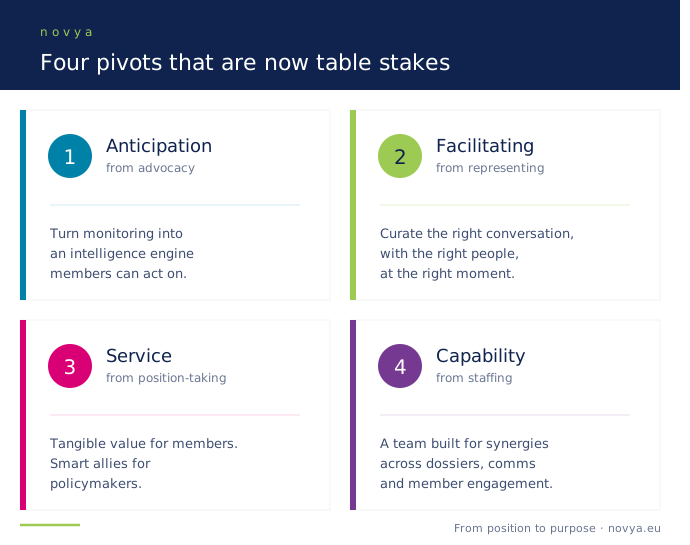
Four pivots EU trade associations need to consider to stay relevant

These forces are not abstract — they show up in association board meetings, staff reviews and member conversations all over Brussels. The question is what to do about them. Four moves are increasingly separating the associations that will matter in the next decade from those that won’t.

1. From monitoring to foresight.

Members don’t want to be educated about EU policy after the fact; they want help seeing what’s coming and understanding what it will mean concretely for their strategy and their balance sheet.

The first move is to turn monitoring into an intelligence engine: foresight, horizon scanning and cross-file scenario work that translates Brussels’ policy bundles into concrete implications for members across the EU. Data tools sit underneath, but the value is in translating information into actionable insight, not the technology. 
Image Description
2. From representing to facilitating
 
Members don’t want to passively add their logo to yet another technical position paper they don’t recognise; they want their leaders in the right rooms at the right moment, with the right preparation. 

A modern association therefore pivots from being the sector spokesperson to becoming an active facilitator. That means more than issuing invitations: it means consulting members upstream, equipping CEOs with the evidence and angles that will resonate, and connecting them with the Commission, national capitals and global counterparts. It works closely with national associations and interest alliances rather than around them, and builds focused coalitions around specific files — sometimes alongside NGOs or academia where interests genuinely overlap. 

The ambition is no longer “we speak for industry X” but “we facilitate the right conversation around file Y, at the right time, with the right people prepared.”  
3. From position to service.
 
Members are increasingly reluctant to fund Brussels-bubble interactions they don’t understand, can’t connect to their business and have no real part in. They want tangible value: intelligence they can act on, convening that opens doors for them, advocacy execution they can measure. 

Policymakers, for their part, never appreciated blanket opposition to over-regulation; but today more than ever they need smart allies — evidence that sharpens their arguments, narratives that help them win votes, and outcomes they can build on. 

The deliverable shifts from a stated view to ongoing useful service. The funding model follows: tiered membership fees, project funding, paid intelligence, sponsored research. Services have value points; positions do not. Service is what delivers impact — to members, to policymakers and to the wider public interest.
Image Description
4. From staffing to capability.
 
If associations want to become strategic partners rather than EU advocacy machines, they will have to ensure they have the capacity to deliver. The internal mix broadens: alongside experienced policy minds, today’s associations need foresight and data analysts, strong communicators, community builders and — above all — active networkers who spend their days building relationships at EU, national and global level. 

No one can work in a silo any more; the new files demand synergies between specialisms that used to sit in separate corners of the building. Leadership evolves with that reality, from a single secretary general expected to carry everything and everyone, towards a strong leadership team of complementary expertise — spanning EU dossiers, nonprofit management, member engagement and external communication — supported by expert consultants and secondments from members. 

None of this diminishes the expertise already inside an association; it equips it to deliver in a much bigger arena.
The next decade will be written by the associations that pivot now
EU trade associations have reinvented themselves before — after the 1970s economic crisis, after the 1992 Single Market, after the 2008 financial shock. The current wave, however, is structural, not cyclical. 

Associations that move from position-taking to purpose-delivery — anticipating, facilitating, serving, and building empowered teams to do it — will help write the next decade of European industrial, climate and competitiveness policy. Those that stay in the old model will find themselves quietly cc’d into conversations their members are already having directly with the Commission, the capitals and the global system around them.

Position-taking made associations matter in the last era. Purpose-delivery will decide who matters in the next.
Image Description
Working through the pivot: At Novya, we work with purpose-driven organisations on exactly this — strategic innovation, smart impact and building capacity. If you would like to compare notes on what comes next for your association, get in touch!
References

Alcohol Action Ireland (2024). Europe’s Beating Cancer Plan: How Big Alcohol lobbying diluted a historic public health breakthrough. https://alcoholireland.ie/europes-beating-cancer-plan-how-big-alcohol-lobbying-diluted-a-historic-public-health-breakthrough/

Atlantic Council (2026). How the Iran war could trigger a European energy crisis. https://www.atlanticcouncil.org/dispatches/how-the-iran-war-could-trigger-a-european-energy-crisis/

Bloomberg (2026). Iran War Threatens the Building Blocks of Europe’s Food and Car Production. https://www.bloomberg.com/graphics/2026-europe-chemicals-iran-war/

BusinessEurope (2026). Omnibook: Reducing the Regulatory Burden, January 2026. https://www.businesseurope.eu/wp-content/uploads/2026/01/2026-01-22-BusinessEurope-Omnibook-to-reduce-regulatory-burden.pdf

Cefic (2024). Antwerp Declaration for a European Industrial Deal, February 2024. https://cefic.org/news/antwerp-declaration-for-a-european-industrial-deal/

CeFPro (2025). European Corporate Climate Advocacy Surges, Trade Associations Lag. https://connect.cefpro.com/article/view/european-corporate-climate-advocacy-surges-but-trade-associations-lag-behind

Cleary Trade Watch (2025). The EU’s latest response to Trump II tariffs. https://www.clearytradewatch.com/2025/04/the-eus-latest-response-to-trump-ii-tariffs/

Corporate Europe Observatory (2024). Don’t let corporate lobbying further water down the AI Act. https://corporateeurope.org/en/2024/03/dont-let-corporate-lobbying-further-water-down-ai-act-lobby-watchdogs-warn-meps

CosmeticsDesign Europe (2025). Beauty business leaders unite to ask EU to guarantee competitiveness. https://www.cosmeticsdesign-europe.com/Article/2025/03/18/beauty-business-leaders-unite-to-ask-eu-to-guarantee-competitiveness/

Draghi, M. (2024). The future of European competitiveness — key findings. https://www.techpolicy.press/draghis-european-competitiveness-report-key-findings/

Euronews (2026). Iran war effects on Europe: is a recession already unfolding? https://www.euronews.com/business/2026/04/23/iran-war-effects-on-europe-is-a-recession-already-unfolding

European Commission (2025). Competitiveness Compass. https://commission.europa.eu/topics/competitiveness/competitiveness-compass_en

ERT (2025a). Reducing the reporting burden, January 2025. https://ert.eu/wp-content/uploads/2025/01/ERT-Reducing-the-reporting-burden-January-2025-Final_V2.1.pdf

ERT (2025b). Members. https://ert.eu/members/

IFPMA (2024). Biopharmaceutical CEO Roundtable. https://www.ifpma.org/blog/initiatives/biopharmaceutical-ceos-roundtable/

Mayer Brown (2025). European Commission presents Omnibus Simplification Package. https://www.mayerbrown.com/en/insights/publications/2025/02/european-commission-presents-omnibus-simplification-package-with-amendments-to-csrd-csddd-cbam-and-taxonomy

The Drinks Business (2025). Alcohol lobby pushes back as WHO hardens stance on drinking. https://www.thedrinksbusiness.com/2025/09/alcohol-lobby-pushes-back-as-who-hardens-stance-on-drinking/

We Mean Business Coalition (2025). From Belém to Brussels: how European companies can keep up the pressure on climate policy. https://www.wemeanbusinesscoalition.org/blog/from-belem-to-brussels-how-european-companies-can-keep-up-the-pressure-on-climate-policy/

WHO (2023). No level of alcohol consumption is safe for our health. https://www.who.int/europe/news/item/04-01-2023-no-level-of-alcohol-consumption-is-safe-for-our-health