From Firefighting to Foresight: How EU Association Leaders Can Drive Strategic Change
EU association leaders spend most of their time reacting — to member demands, policy shifts, and operational crises. This hands-on roadmap from the Novya Leadership Lab helps you break the cycle: spot change signals early, gather just enough evidence to act, and bring your board along for the ride.

- 16 April 2026
8 min read

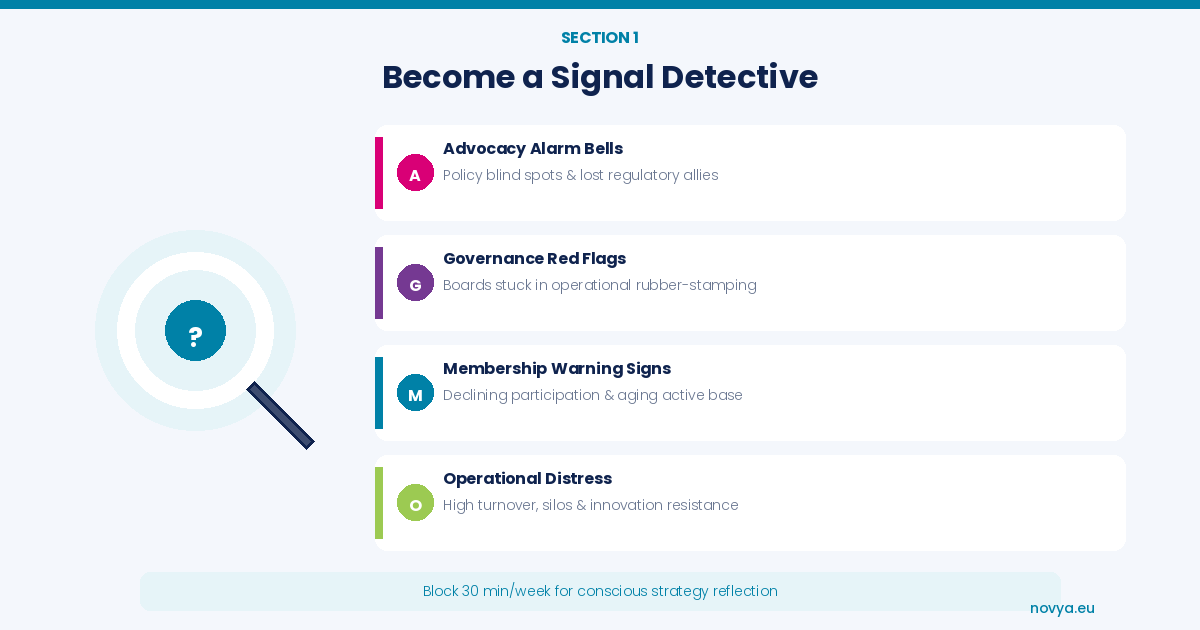
1. Become a Signal Detective
Major crises don’t materialise from thin air — they send out invitation cards first. These early signals are your canaries in the coalmine: indicators that your current operating model might be approaching its sell-by date.
The key insight? Signals should guide attention, not trigger panic. They tell you where to look — not what to do immediately.
Here are the signals EU association leaders cannot afford to ignore:
- Advocacy alarm bells. You’re losing close connections to EU regulatory allies. Policy blind spots are leading to missed opportunities. If this sounds familiar, your positioning strategy needs a refresh.
- Governance red flags. Board agendas are dominated by operational rubber-stamping. Committee work is 99% secretariat-driven. This is your cue for governance evolution — moving the board from oversight to genuine strategic partnership.
- Membership warning signs. Committee participation is declining. Your active member demographic is aging. New market players show zero interest in joining. When these converge, your value proposition is getting stale. Operational distress signals. High staff turnover, persistent silos, and a general culture of innovation resistance. These point to an operating model that needs redesign, not just a pep talk.
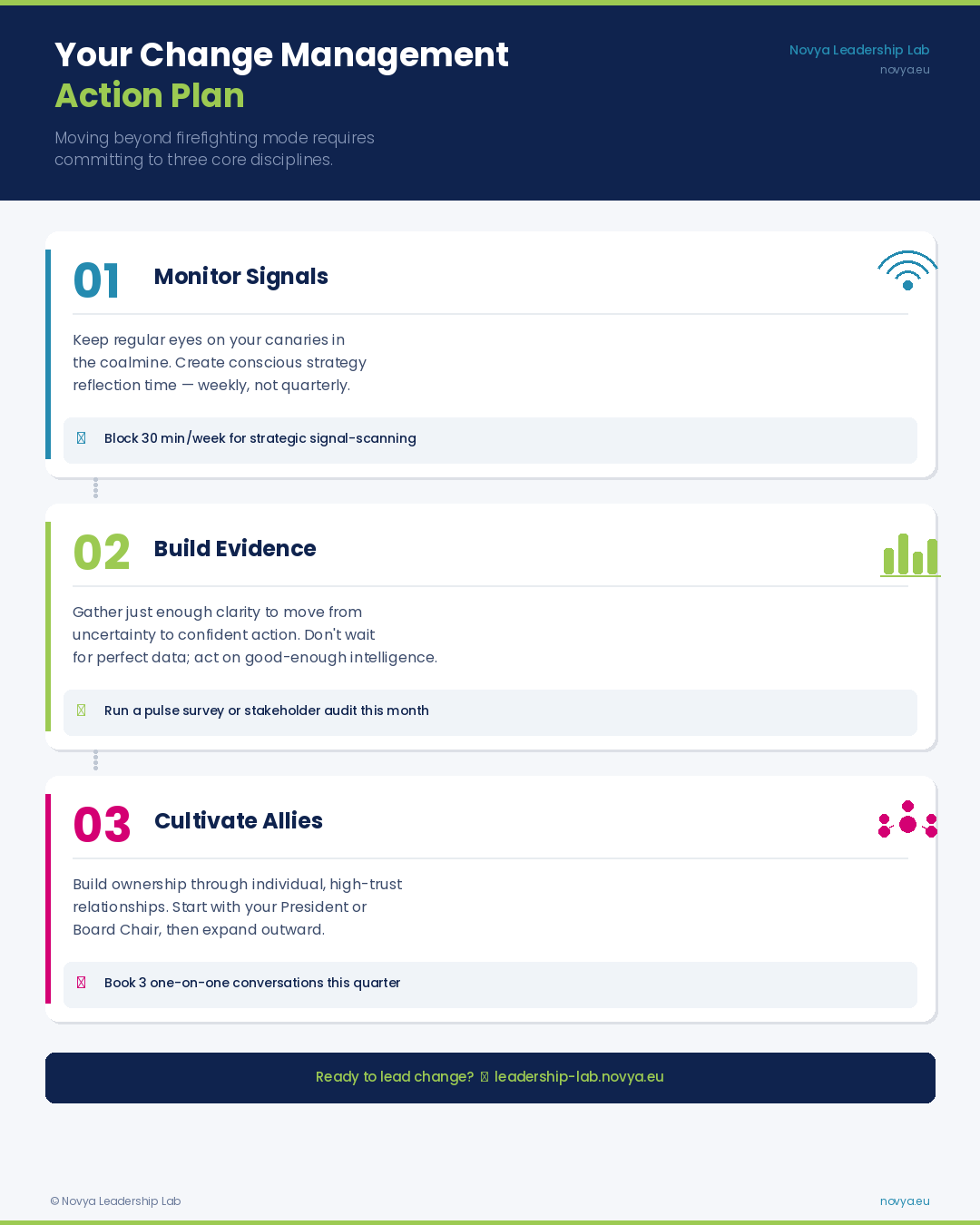
What to do about it: Create a workflow for conscious strategy time — even just 30 minutes a week — to observe and reflect on these signals. Block it in your calendar the way you would a meeting with a key stakeholder. Because that’s exactly what it is.
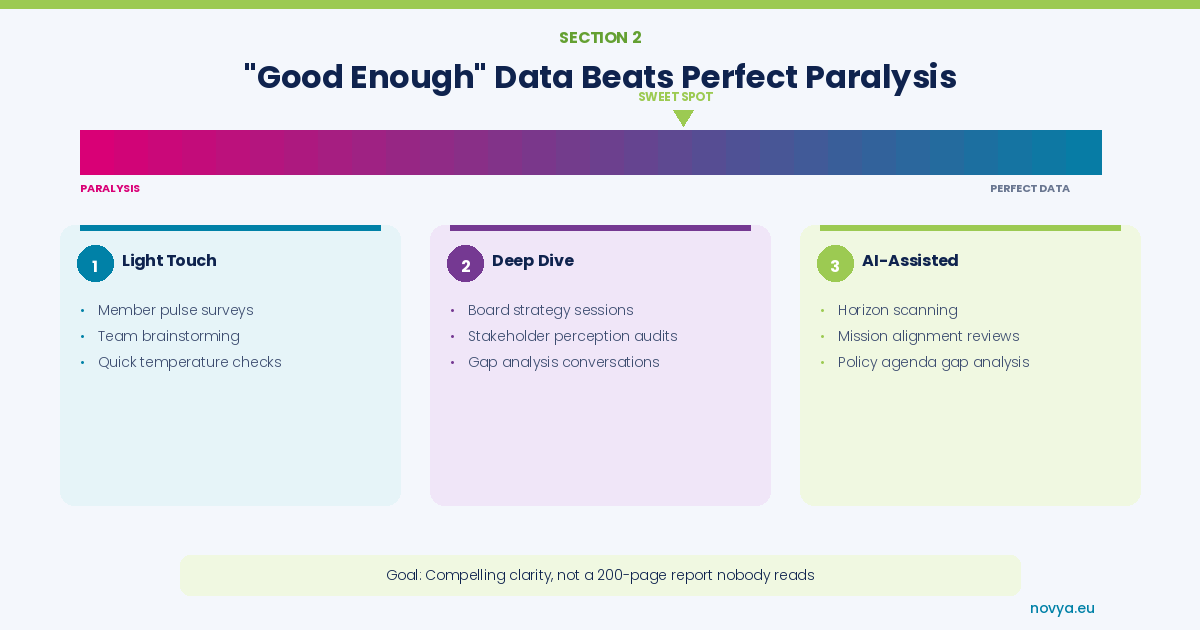
2. “Good Enough” Data Beats Perfect Paralysis
Here’s where many of us get stuck: waiting for 100% certainty before proposing any shift. In our volatile policy environment, perfect data is about as real as a quiet week in Brussels.
You don’t need certainty for change management. You need clarity — enough evidence to decide for yourself and enough to convince the biggest sceptic in your boardroom that it’s time to move.
- Start with a light touch. Member pulse surveys are quick and painless. Team brainstorming sessions help you gauge the internal temperature. These low-effort tools give you a directional read without paralysing the organisation with a six-month research project.
- Then go deeper where it matters. Strategy sessions with board members on sector trends. EU stakeholder perception audits — how you’re actually perceived versus how you think you’re perceived. These are the conversations that surface the real gaps.
- Let technology help. AI-powered tools can act as your horizon-scanning partners. Use them for quick reviews of your association’s mission alignment, sector shifts, and policy agenda gaps. They won’t replace your judgment, but they’ll accelerate your preparation.
The goal isn’t a 200-page report that nobody reads. It’s compelling, clear evidence that shifts your leadership team from operational thinking into strategic mode.
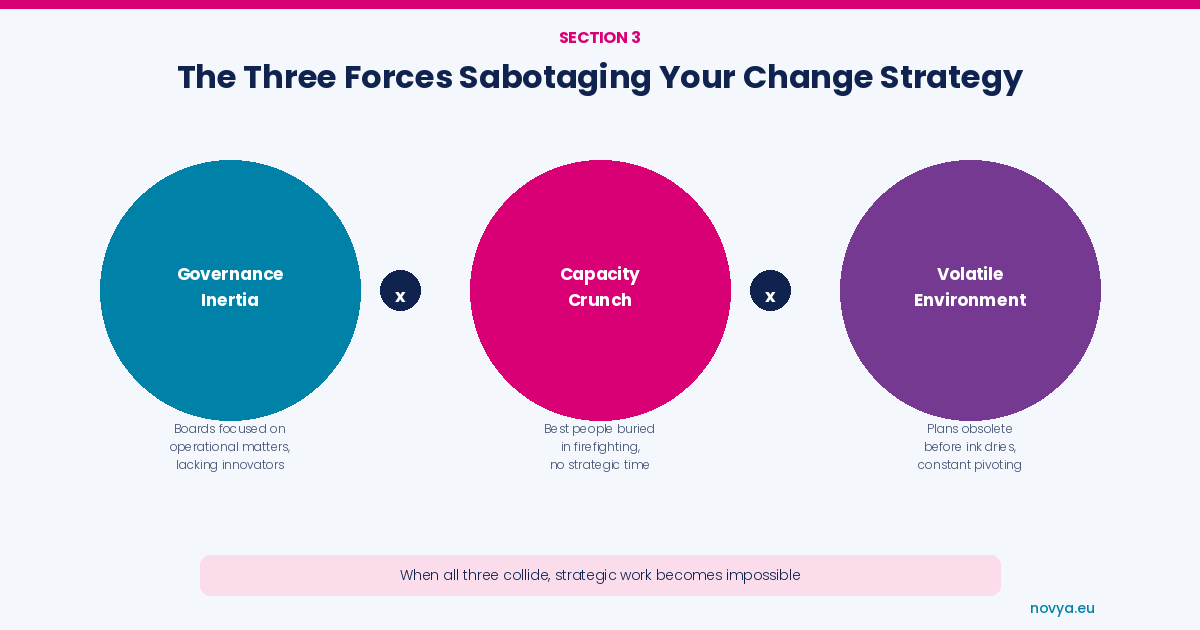
3. The Three Forces Sabotaging Your Change Strategy
Associations have built-in inertia — a tendency to stay comfortable until absolutely forced to change. When you try to move forward, three forces don’t just coexist; they collide.
- Governance inertia. Boards comfortable with the status quo, focused on operational matters, often lacking representation from sector innovators and disruptors. They’re not blocking change on purpose — they simply aren’t equipped to drive it.
- Internal capacity crunch. Your best people are so buried in firefighting that long-term goals become “extra credit” they never reach. When your team is running at 110% just to keep the lights on, strategic work doesn’t stand a chance.
- Volatile environment whiplash. Your plans become obsolete before the ink dries. A new EU regulation, a geopolitical shift, a funding landscape change — and suddenly your carefully designed strategy is out of date. When this volatility meets governance inertia, your plan is dead on arrival.
The hard reality: When all energy goes to “business as usual” plus “day-to-day survival,” creating those crucial step-back moments becomes nearly impossible. Recognising this pattern is the first step to breaking it.
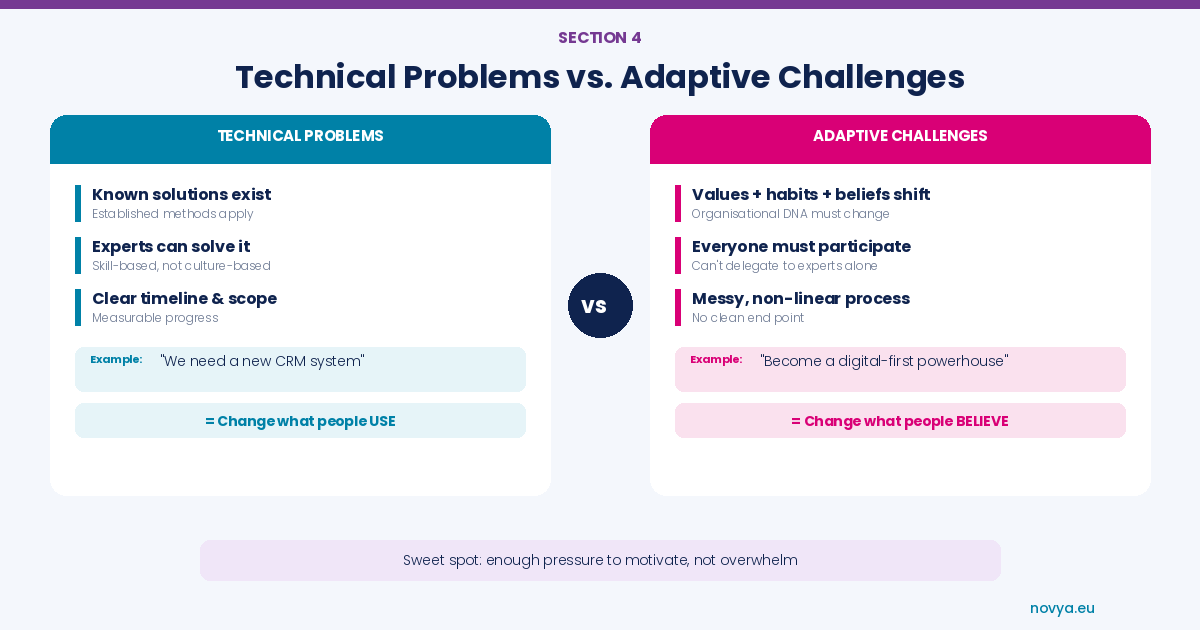
This is where change initiatives in associations most often crash and burn: treating adaptive challenges like technical problems.
- Technical problems have known solutions. “We need a new CRM system” is a technical problem. You can solve it with the right vendor, the right budget, and established implementation methods.
- Adaptive challenges require a shift in values, habits, and beliefs. “We need to stop being a comfortable club and become a digital-first advocacy powerhouse” — that’s adaptive. It requires fundamental change in organisational DNA, and no consultant or software purchase can shortcut the process.
The leadership sweet spot lies in managing what researchers call the “productive zone of disequilibrium” — applying enough pressure to motivate change without creating chaos that makes everyone shut down.
This is the hard part of association leadership: to move forward, we have to release “how we’ve always done it.” And yes, that process is uncomfortable. But the discomfort of intentional change is always more manageable than the discomfort of being left behind.
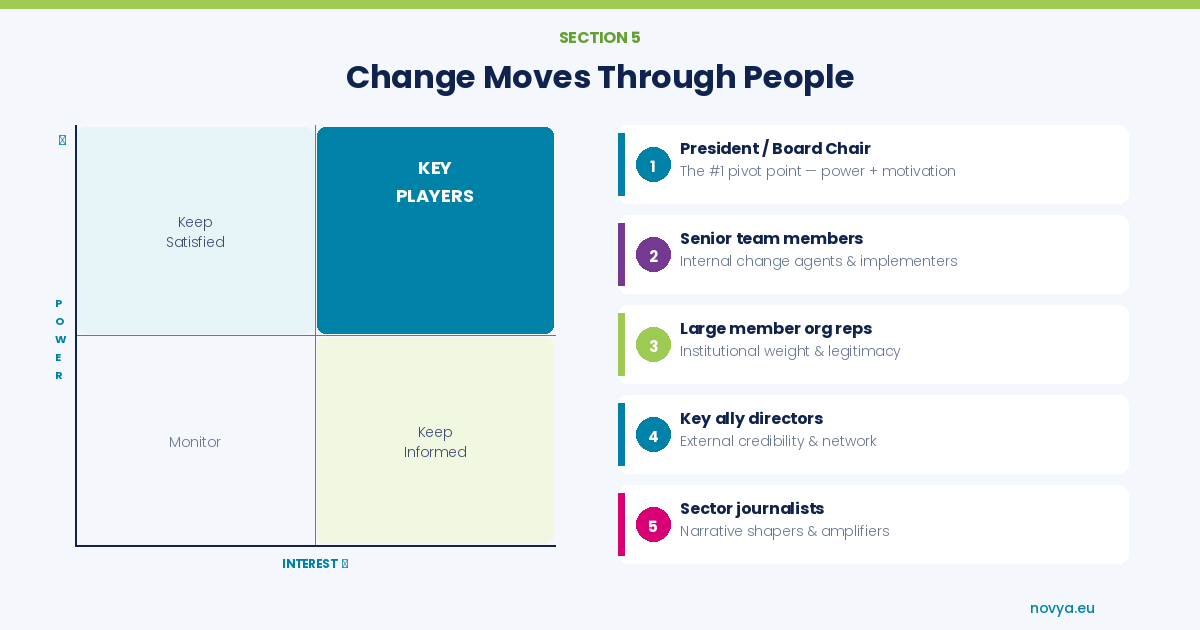
In associations, change is never a top-down mandate. Successful implementation is a social process. It starts when you map your stakeholders on a Power/Interest Matrix and identify who actually holds the keys to decision-making.
Here’s what our Leadership Lab research consistently shows: the most critical stakeholder isn’t “the whole board.” It’s always a specific person or group of individuals.
The President or Board Chair is overwhelmingly the pivot point. Why? They’re your most likely candidate for having both the power and the motivation to move the collective forward.
But don’t stop there. Senior team members, active representatives from large member organisations, executive directors from key allies, sponsors, and sector journalists — these gatekeepers can accelerate or derail your change initiative. Identify them early, understand their motivations, and invest in those relationships before you need them.
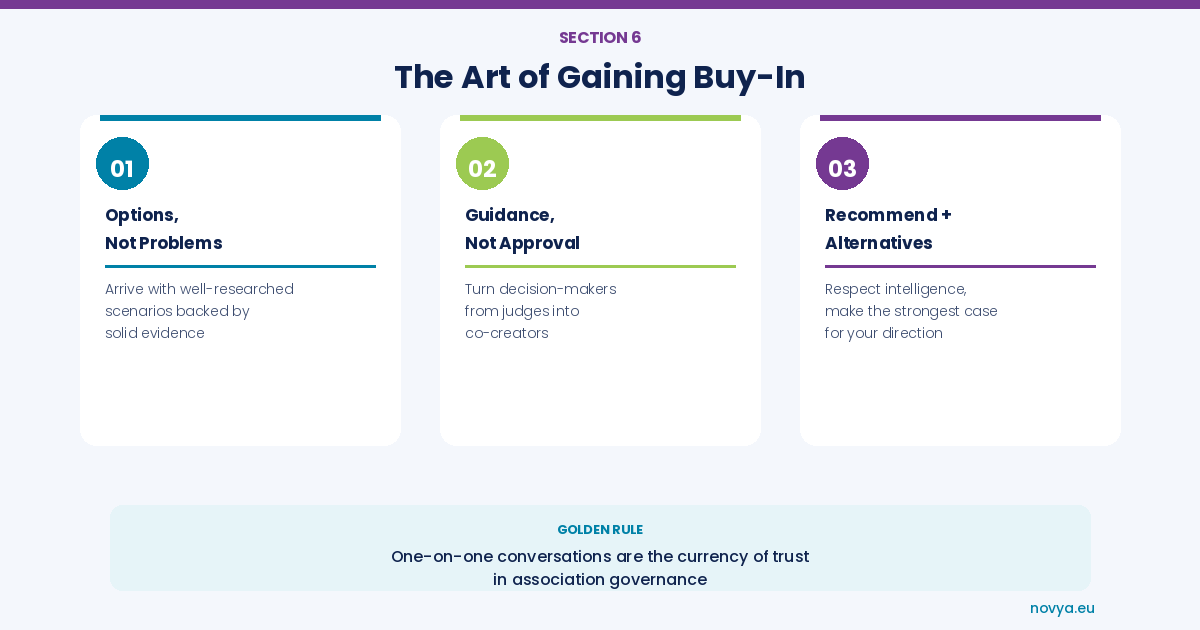
Getting alignment isn’t about “selling” change. It’s about inviting people into the process. Here are three approaches we’ve seen work consistently across European associations:
- Come with options, not problems. Skip the doom-and-gloom presentation. Arrive with several well-researched scenarios backed by solid evidence. This demonstrates competence and steers conversations toward solutions rather than roadblocks.
- Ask for guidance, not approval. People are far more likely to support initiatives they feel they’ve helped shape. When you ask a board member for their “advice” rather than their “sign-off,” you transform them from judge to co-creator. It’s a subtle but powerful shift.
- Present your recommendation alongside alternatives. Give your preferred path the strongest evidence base, and present it alongside one or two other options. This respects your stakeholders’ intelligence while making the strongest case for your direction.
One principle underpins all of this: one-on-one conversations are the currency of trust in association governance. They unlock the candid feedback and genuine alignment you’ll never get in a formal board meeting.
The next time you feel overwhelmed by the relentless pace of association life, take a deep breath and ask yourself:
“What’s the one signal in my association right now that’s actually an invitation to lead?”
Change isn’t something that happens to your organisation — it’s your opportunity to step up and guide it toward its next evolution. And in today’s European policy landscape, the associations that thrive will be the ones whose leaders chose to be strategic when everyone else was still being busy.